Reduced Task Time by 80% and Improved Usability (SUS 65 → 77.5) Through a Scalable Design System
Designed a scalable system that adapts to user behavior, improving efficiency and engagement
Context
Mental wellness apps often leave users navigating emotionally heavy flows alone.
As the designer and researcher on this internal MVP, I conducted interviews, surveys, and competitive analysis with 30 participants. A clear pattern emerged: users were not disengaging because the tools were broken. The experience felt impersonal and repetitive. It is more like filling out forms than being supported.
opportunity
The opportunity was to rethink how we could support users both functionally and emotionally, across user journey.
The objective was to design a system that creates a continuous sense of companionship across the full product journey.
System Thinking
| a unified UX system
I built around a constant in-app character acting as both an emotional and functional layer. This was a system with defined logic, context-aware behaviours, and deliberate reuse across the entire product.
The character appears across the journey. This reduces isolation and creates a sense of shared progression
| Context-aware behaviour system
The character responds differently based on user’s state:
encouraging during focus tasks
guiding through diagnosis
celebrating milestones
This transforms it from a visual element into a responsive system component that supports clarity and motivation.
| reward and feedback system
Users earn stars by completing actions across diagnosis, focus tasks, diary, and meditation. Stars unlock character customisation: shape, colour, and accessories — creating a feedback loop that reinforces engagement across the whole product.
Methods and Iteration
| The research began with emotional mapping
The research began with emotional mapping. Through interviews and surveys, I identified the emotional states users typically brought to each feature:
anxiety before diagnosis
low motivation before focus tasks
emotional heaviness during daily diary entries
These states became guiding inputs for design. Each feature was shaped to meet users where they are, supporting them in the moment.
| An important challenge
An important challenge emerged early on, when some users perceived the character as infantilising. I used this insight to sharpen the design principles, focusing on warmth without unnecessary cuteness. The visual language was refined to be more restrained, guided by a clear rule: supportive, never patronising.
| Reducing Friction
From there, iteration focused on reducing friction at moments of highest emotional load.
Task creation was simplified from three steps into one
Diagnosis flows were restructured to make progress more visible
Colour complexity was reduced while preserving emotional warmth
Outcome
Quantitative impact
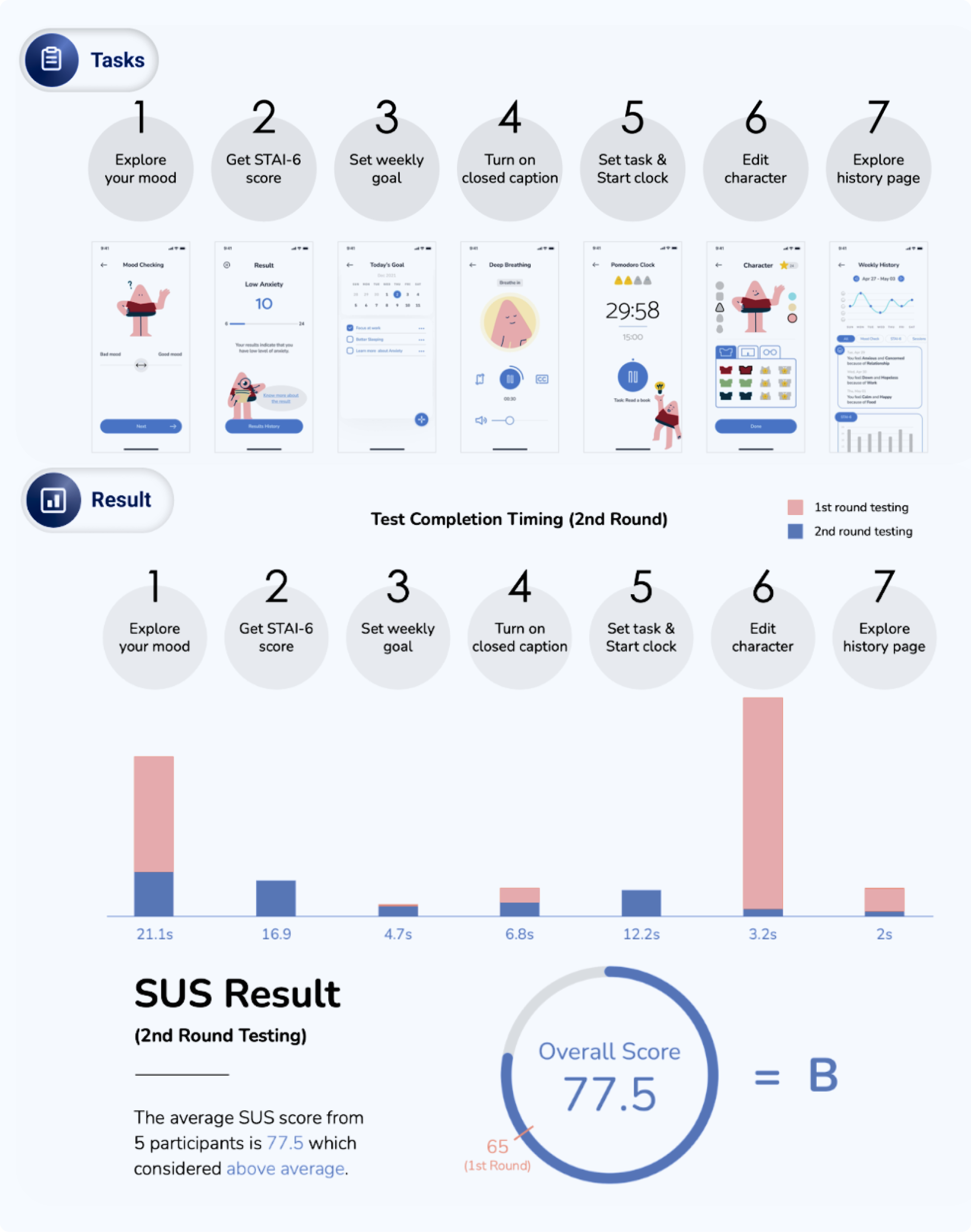
Daily mood check time dropped from 1 minute 16 seconds to 21.1 seconds, a 72% reduction
Diagnosis completion increased by 45% for STAI-6 assessments, with an average task time of 16.9 seconds
The SUS score improved from 65 to 77.5, moving from marginal to good usability
User experience impact
Users reported feeling less alone during emotionally heavy flows
Complex tasks became easier to complete, and engagement increased because the experience felt coherent and rewarding rather than fragmented
System impact
|
A scalable emotional layer now unifies multiple features into a single interaction model, creating a reusable foundation for future expansion.
Key learnings
| A good design system can shape behavior
Adaptive UX works best as a system, not a set of isolated features
System thinking turns emotional design into a practical tool for reducing friction and improving task completion
Well-designed adaptive systems make complex interactions feel more approachable and easier to navigate
Emotional design is not about adding personality, but about defining consistent rules for how a product behaves over time
The next step is deeper adaptability, moving from reacting to user actions toward responding to user state through more personalised and context-aware behaviour